CV Screener
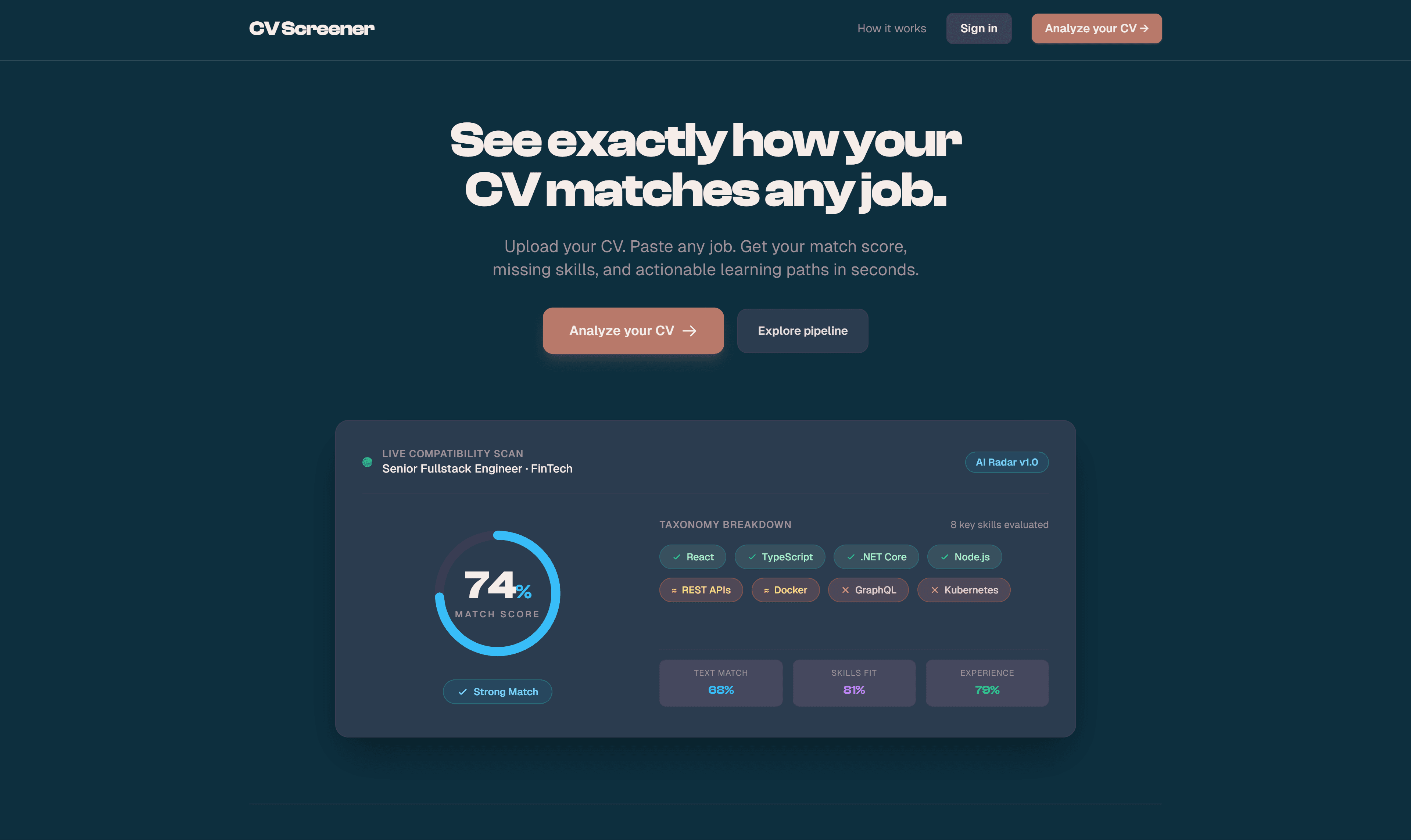
Not just a score — an explainable three-dimensional breakdown of why your CV fits (or doesn't) a job.
At a Glance
The Problem
Job seekers send CVs blindly and never know why they're rejected. Recruiters process hundreds of applications manually with no objective ranking. Existing ATS tools give a score but no explanation — candidates can't act on "68%". CV Screener was built to surface exactly which dimension is dragging the score down and give users a concrete next step to fix it.
The Solution
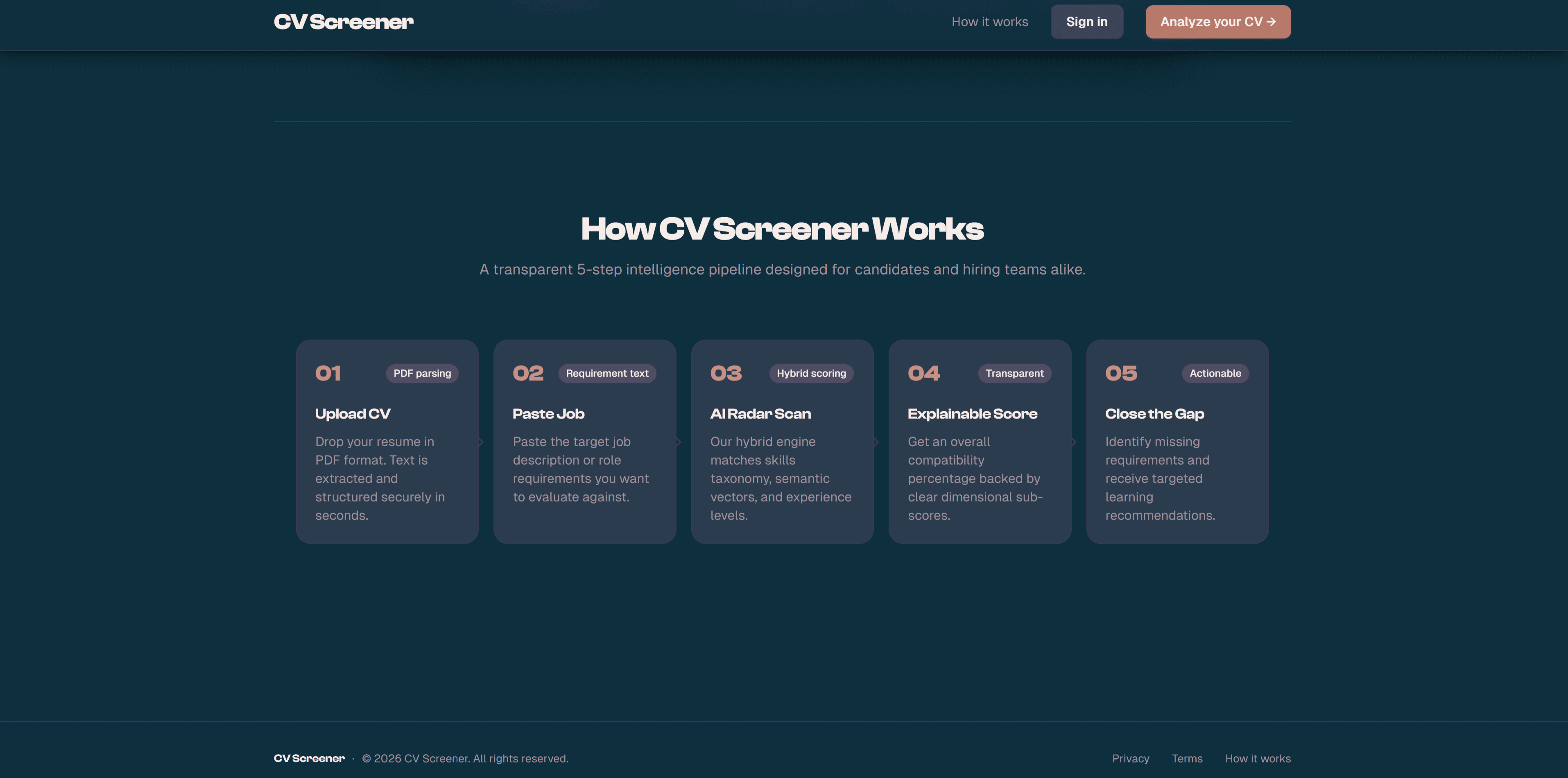
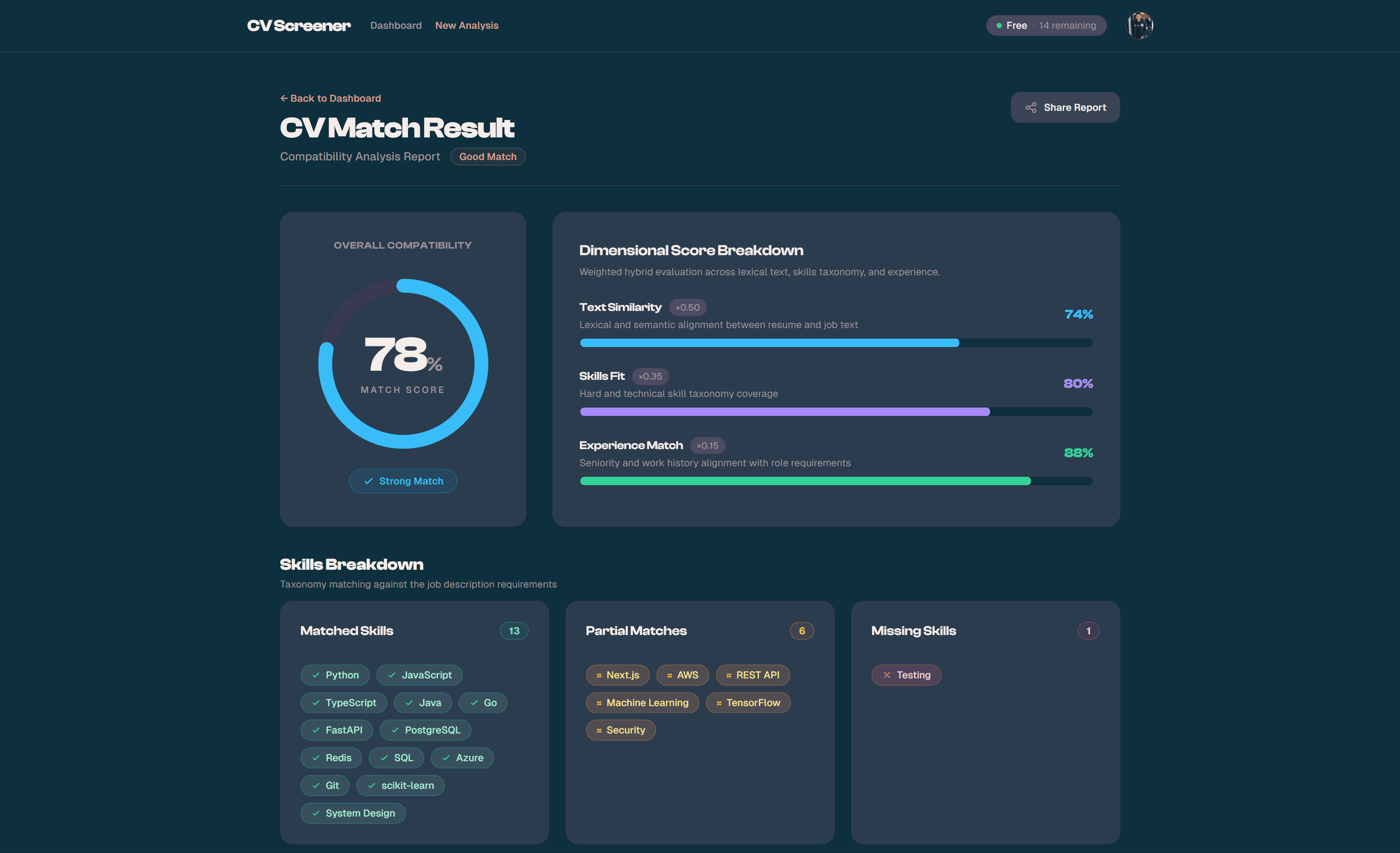
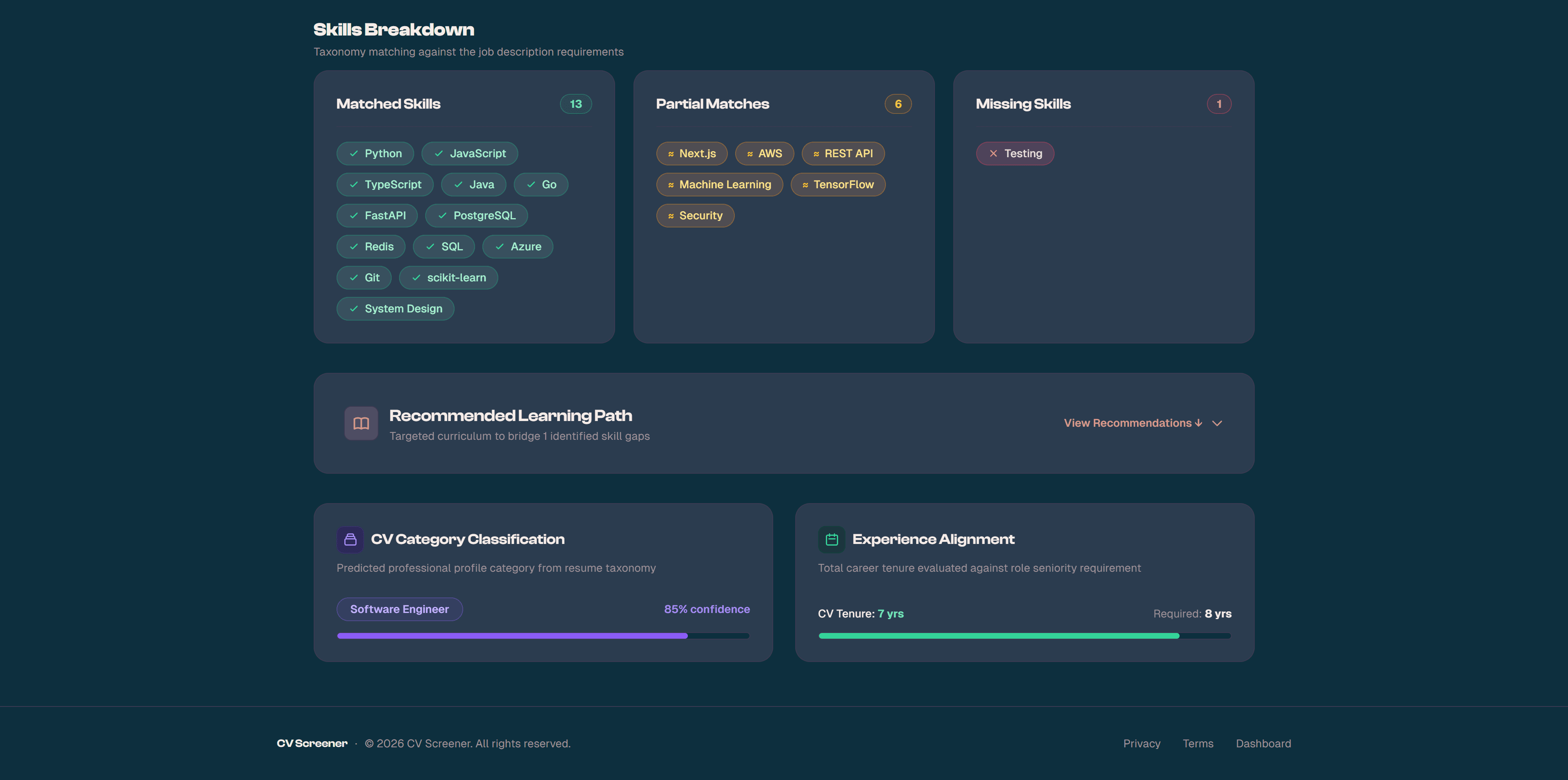
A fixed three-component weighted hybrid score: Text Similarity via a TF-IDF model (trained on 9.4 MB of real job descriptions, exported to ONNX, inferred in .NET — no Python in production); Skills Score via a curated taxonomy of 50 canonical skills with alias mapping; Experience Score via regex year extraction with a continuous ratio formula. Every result shows all three scores separately, a Matched/Partial/Missing skill breakdown, and a personalized learning path for every gap.
Architecture
- →Backend: .NET 8 Web API with strict Clean Architecture — Core → Infrastructure → API. Zero external NuGet packages in Core. DI registered entirely in Program.cs.
- →Frontend: Next.js 14 (App Router), TypeScript, Tailwind CSS, Clerk authentication. All API calls routed through a typed Axios lib layer.
- →Database: PostgreSQL via Supabase with raw Npgsql SQL — intentionally no ORM. RLS enabled for row-level security.
- →ML Pipeline: Python scikit-learn TF-IDF trained on 9.4 MB corpus → skl2onnx ONNX export (166 KB, 5000-word vocabulary) → Microsoft.ML.OnnxRuntime Singleton inference in .NET.
- →Infrastructure: Vercel (frontend), Railway (backend .NET API), Supabase (PostgreSQL), Clerk (JWT auth + user management).
- →Score labels (Poor / Below Average / Average / Good / Excellent) computed server-side to prevent client-side manipulation.
Key Features
- ✓Hybrid AI scoring: TF-IDF semantic similarity (50%) + Skills Taxonomy (35%) + Experience rules (15%) — three-dimensional, not a black box
- ✓PDF CV upload with PdfPig text extraction — file never stored, only extracted text persists (privacy by design)
- ✓Three-tier skill classification: Matched / Partial / Missing against a curated 50-canonical-skill taxonomy with alias expansion
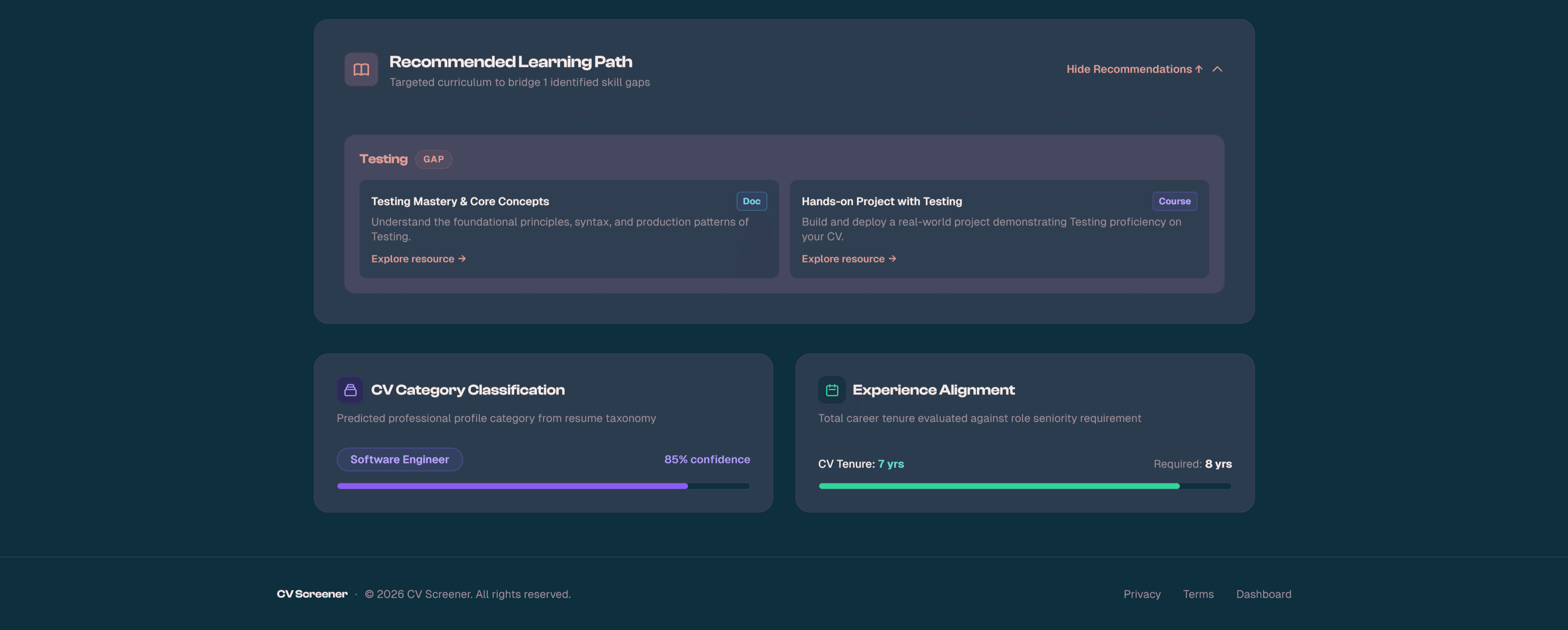
- ✓Personalized learning path generated for every missing skill — targeted Doc/Course resources to close identified gaps
- ✓Public share links via UUID — no auth required to view a shared analysis report
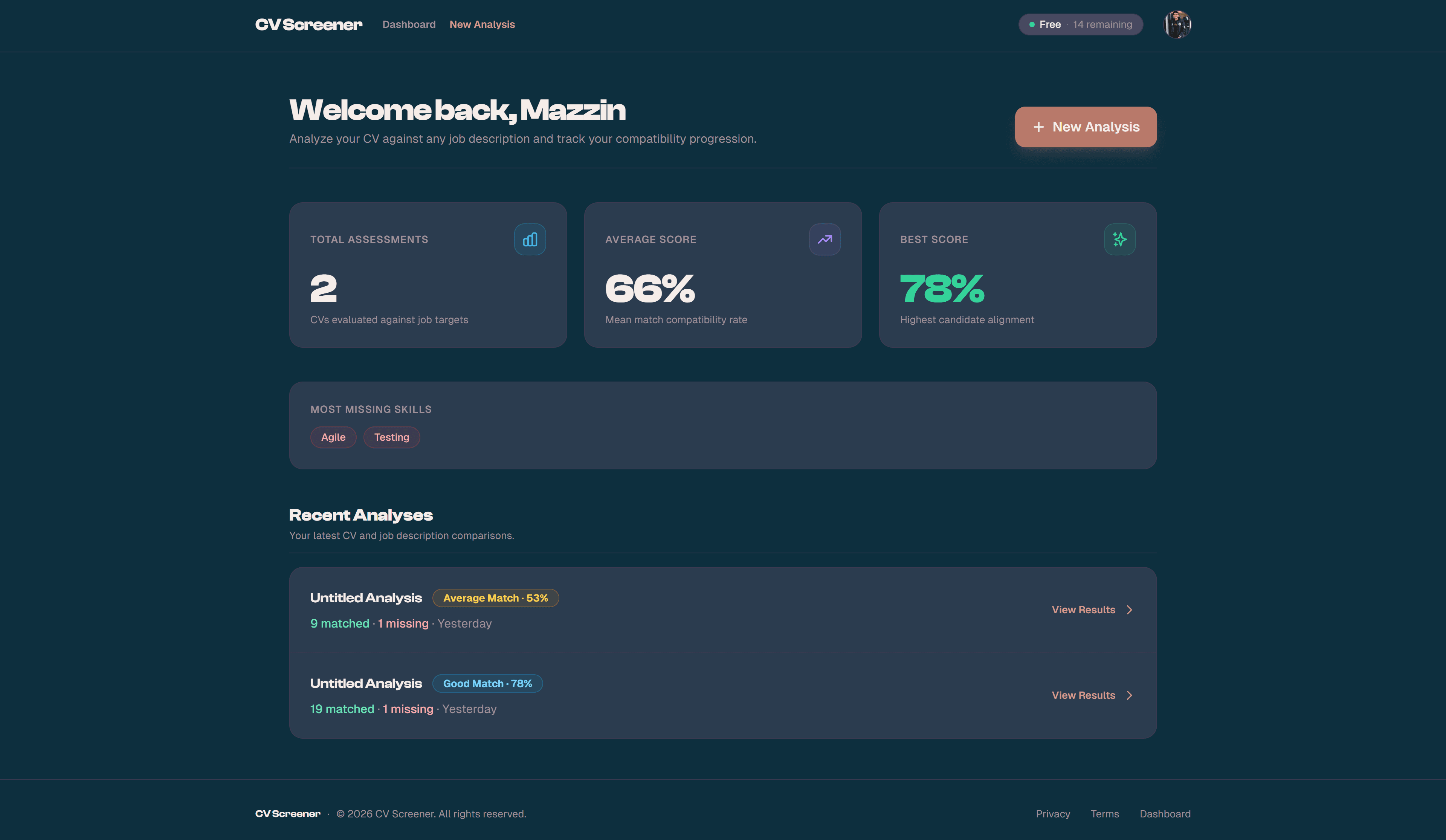
- ✓Analysis history (last 50 per user) with score progression tracking
- ✓User dashboard with aggregate metrics: total analyses, average score, best score achieved
- ✓Role-based onboarding (Job Seeker / Recruiter) with Clerk JWT authentication
- ✓ONNX ML inference running inside .NET as a Singleton — no Python runtime in production
- ✓Strict Clean Architecture: Core → Infrastructure → API, with zero external NuGet packages in Core
Screenshots

Code Highlight
Challenges & Solutions
🎯 Running a Python-trained ML model inside a .NET production environment without a Python runtime dependency
Trained a TF-IDF model with scikit-learn, exported it to ONNX format via skl2onnx, then loaded it inside .NET via Microsoft.ML.OnnxRuntime as a Singleton service. InferenceSession is thread-safe — the model loads once at startup and serves all concurrent requests with zero Python involved.
🎯 Skill matching that handles terminology variance — ".NET" vs "ASP.NET Core" vs "dotnet"
Built a curated Skills Taxonomy JSON with 50 canonical skills, each with a list of known aliases. The SkillsEngine performs canonical matching first, then alias matching (counted as partial at 0.5 weight) — ensuring skill coverage is accurate across the wide variation in how technologies are named in CVs vs. job descriptions.
🎯 Designing a scoring formula that is explainable and resistant to single-dimension gaming (CV keyword stuffing)
Implemented a fixed three-component weighted formula (50/35/15). Each dimension is surfaced separately in the UI — users can see exactly which score is dragging them down, and a candidate who keyword-stuffs their CV will see high Text Similarity but low Skills/Experience scores, exposing the manipulation.
Tech Stack
What I Learned
- 💡ONNX is the right bridge between Python ML training and .NET production inference — training stays in Python's rich ecosystem while inference stays in a type-safe, dependency-free runtime.
- 💡A curated taxonomy beats raw keyword matching: alias expansion dramatically reduces false negatives where a skill is present but named differently.
- 💡Explainability is a feature, not an afterthought — surfacing each dimension separately makes the product trustworthy and actionable, not a black box.
- 💡Clean Architecture's payoff is most visible at integration points: swapping the ONNX model version required changing only OnnxInferenceService, with zero changes to MatchingService, controllers, or DTOs.
Links
Interested in a similar solution?
Let's discuss how I can build something like this for your business.